

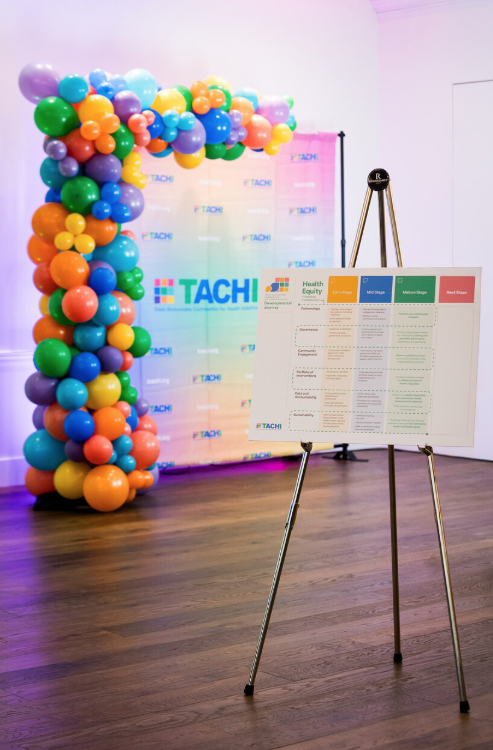
On December 4 and 5, leaders from across Texas came together for the final statewide convening of the Texas Accountable Communities for Health Initiative (TACHI). The gathering marked five years of progress made possible through funding support from Episcopal Health Foundation and St. David’s Foundation, and it created space to reflect, celebrate, and look forward.
Since its launch, TACHI has supported six communities in building locally driven, cross-sector approaches to health by addressing non-medical drivers, strengthening partnerships, and centering the voices of those closest to the challenges. That evolution was evident throughout the convening; from the structure of the sessions to the tone in the room. It was a recognition that the work has reached a new stage of strength.
A Shared Vision, Five Years in the Making
The convening opened with welcome remarks from Dr. Ann Barnes, President and CEO of Episcopal Health Foundation, and Dr. Edward Burger, President and CEO of St. David’s Foundation. Both reflected on the early aspirations of TACHI and the reality that now exists because of the commitment of site leaders and partners.
When TACHI launched, Dr. Barnes shared, the vision was clear: name and address the non-medical factors that shape health, foster authentic collaboration across sectors, and ensure the work could endure beyond philanthropy. Five years later, she noted, those hopes are no longer aspirational, but are visible in practice.
Dr. Burger echoed that sentiment, emphasizing that the success of TACHI rests in how sites adapted the Accountable Communities for Health model to fit their local context. Across Central Texas and beyond, sites imaginatively tailored strategies to address food insecurity, maternal health, workforce development, and the vital role of community health workers; demonstrating what becomes possible when trust and local expertise lead the way.
Strengthening the Stories That Move Systems
Thursday evening grounded participants in narrative as a tool for change. In a storytelling workshop led by Josh Grynewicz of Odd Duck Consulting, sites explored the distinction between story and narrative and how each can be used to shift public conversation.
Rather than relying on traditional “problem–solution” storytelling, participants were introduced to a radical future narrative framework; one that begins with possibility, names present realities, acknowledges obstacles, and invites others into a shared vision of what could be. The session reinforced that how communities tell their stories can shape not only perception, but policy, partnerships, and action.

Learning From the Journey, Together
Friday’s agenda centered on reflection and collective learning. An evaluation presentation by Dr. Eileen Nehme highlighted progress across partnerships, infrastructure, and shared learning, underscoring how collaborative capacity has grown across all six sites.
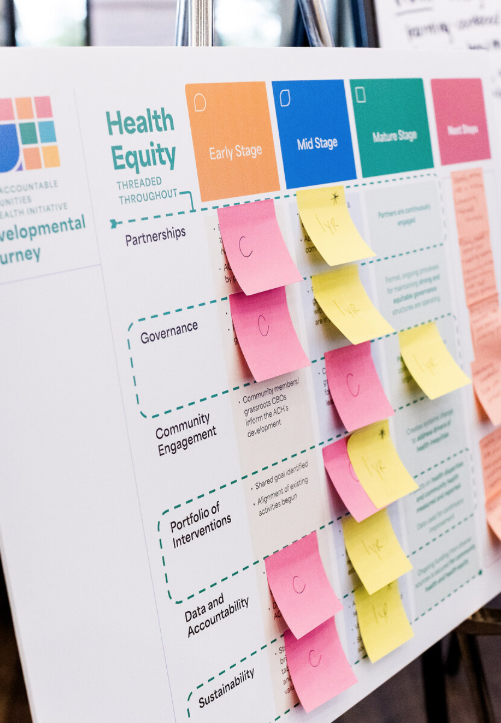
That learning came to life during a participatory Developmental Journey World Café facilitated by Sue Grinnell of the Population Health Innovation Lab and Dana Perlman of the Change Leaders Network. Site teams assessed where they are today along the Developmental Journey, articulated where they want to be in one year, and identified the domain areas and actions that will move them forward.
Through gallery walks and peer exchange, sites shared resource needs, offered support to one another, and surfaced patterns across communities—highlighting both how far the work has come and where collective growth continues.
Looking Forward With Hope and Imagination
The convening concluded with a hope-centric visioning exercise that invited participants to articulate the future they are actively building. The themes were consistent: confidence in the work, clarity about next steps, and a willingness to continue experimenting—even when outcomes are uncertain.
Dr. Burger encouraged sites to embrace imagination and what he called “effective failure,” recognizing that innovation requires risk and that learning often comes through iteration.
A New Chapter, Built on What Works
The formal TACHI initiative concludes at the end of 2025, but the work itself is not ending. What began as a funded initiative has matured into durable partnerships, shared language, and community-led structures that will continue to evolve.
As Dr. Barnes reminded participants, “If you want to go far, go together.” The strength of TACHI lies not only in what has been accomplished over the past five years, but in the capacity that now exists across communities to keep going—together.
The next chapter of this work is already underway.
Learn more and receive updates at https://www.episcopalhealth.org/